AI integration that fits your product
Practical LLM and ML features wired into real workflows — with evaluation, cost controls, and a path your engineers can maintain.
- Proof-of-concepts that never leave a notebook
- Unclear data readiness for model or RAG features
- No evaluation plan, so quality regressions go unnoticed

What we deliver
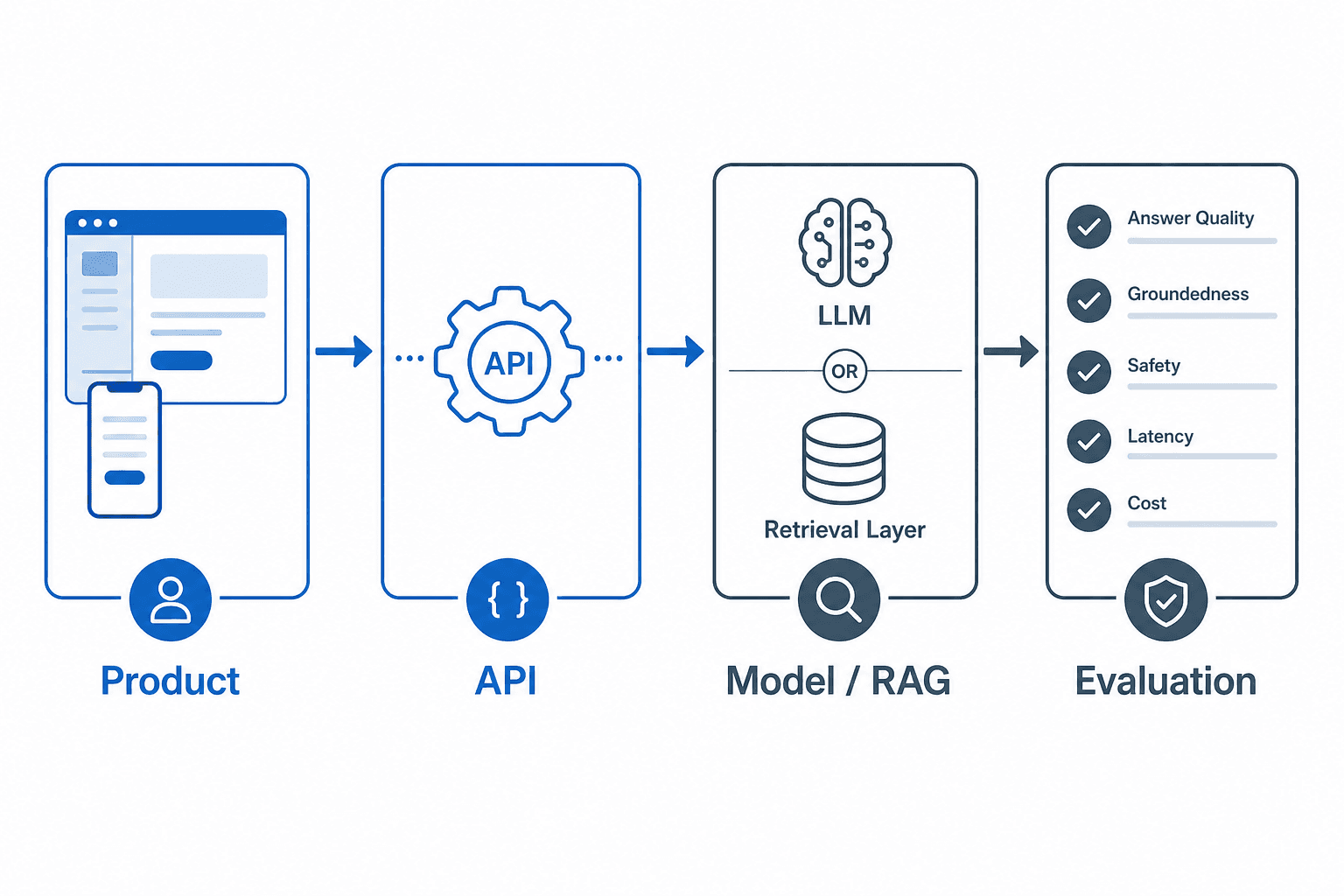
Product and engineering teams are under pressure to add AI. The risk is shipping a demo that cannot be evaluated, governed, or costed. We integrate AI where it changes a specific workflow.
- Use-case scoping with success criteria
- Prompt and tool design with guardrails
- API integration into your application
- Document ingestion and chunking approach
- Retrieval pipeline with basic relevance checks
- Citation or source display where useful
- Feature and label definition with your domain experts
- Training and evaluation pipeline
- Deployment path with monitoring hooks
- Golden-set examples for regression checks
- Token / cost visibility for production calls
- Runbooks for common failure modes
How we work
- 1
Qualify the use case
Confirm the workflow, data access, and whether AI is the right lever at all.
- 2
Prototype against real data
Build a thin vertical slice with measurable quality, not a slide demo.
- 3
Integrate
Wire into your product with auth, logging, and cost controls.
- 4
Evaluate & hand over
Leave an eval set, docs, and ownership so your team can iterate safely.
Technologies we work with
Stacks and platforms we use on this kind of work — not a partnership claim.
Models & platforms
- OpenAI
- Hugging Face
Frameworks
- Python
- TensorFlow
- PyTorch
Cloud
- Azure
Patterns
- RAG
Common questions
Do you build custom models from scratch?
Only when the use case and data justify it. Many product features are better served by carefully integrated foundation models with evaluation and guardrails.
What about data privacy?
We design to your data-handling requirements — including options that keep prompts and documents within your cloud tenancy where the provider supports it.
How do we know the feature is good enough to ship?
We agree success criteria and a small evaluation set up front. Shipping happens against those checks, not against a vague sense that the demo looked good.
